
Knocknaveen
- a short story of grief and acceptance

Knocknaveen
-by S. Francis Burns
The posted notice said: OUT OF SERVICE / AS SEIRBHÍS. He read the Irish aloud, soft, unsure.
“Means the same thing as English, only wetter,” she said from the doorway.
Roonagh Pier was a wet concrete shape and a low room with a heater that clicked, sighed, died. He put a hand near it anyway.
“It works a treat in July,” she said, not moving, not making more of things than they were.
“You accept a card for the fare?” he said, fearing the answer.
“We take cash and waiting.” She pulled a yellow jacket closer at her throat. “Mostly waiting.”
He found coins in his jacket pocket. One of the euro pieces slid off his damp fingers, rang once, skittered to the edge, and slipped through the floor slats to the sea with a small, neat plink.
“That one’s for the harbor.” She didn’t move. “You’ll get no receipt.”
“I’ll pay when we move,” he said.
“That’s the custom.”
He put the coins back in his pocket. The heater tried again and gave up again.
Fog rolled in from Clew Bay and laid itself on the ropes, on the weeded ladder, on the window that didn’t quite seal. A gull made a complaint to no one that cared.
“Pump’s gone awkward,” she said. “Kyle’s on his way.”
He nodded. The word pump landed square, something that belonged to hands and wrenches, not to thoughts. The room held a timetable curling at one corner, a St. Brendan print tacked crooked above it. He liked the crookedness. St. Brendan stared on, patient in his small crooked sea. It felt like a comment on the day.
Outside, the water holding the pier breathed slow. He followed her out to the edge where the breast rope sagged and drew up with a wet sound. She kicked a coil right with the toe of her boot. Her knit cap was pulled down low. Under her jacket, a small square pressed against the cloth, a folded card, glossy edge showing. She pressed it flat and took her hand away.
A van emerged first as a shape, then a grille showed, then the whole of it. The mechanic got down with a toolbox that had lived a full life. He nodded without looking at either of them and knelt by the intake. The ratchet began, stopped, began again, stopped.
Next, a pallet jack squealed out of the fog with beer kegs. A deckhand caught two of them with his boot when they kissed and rolled an inch.
“We’ll call that lashed,” the deckhand said.
“Language,” the woman said from the wheelhouse doorway without turning her head.
“Apologies,” he said to the kegs.
“Emergency supplies,” the ferrywoman said.
“For mine!” the mechanic said with a smile, reaching for a spanner.
Another pallet came, flour in stacked white bags tight under stretched film, then a bin stamped POST, then two banded propane cylinders with a rusty belt. The deckhand glanced at the sky, as if it could be negotiated with.
“Can I give a hand?” the man asked.
“Insurance doesn’t cover eager,” the deckhand said kindly. “But you can look like you’re helping.”
He stood out of the way. The sea came up the piles for a breath and went down again. The fog made everything look the same distance.
The mechanic spoke to the steel in a steady voice. The ferrywoman raised a flask to her mouth, paused, and didn’t drink. She watched the lines, then the lift of the water, then the gauge. He liked how she did that. It was a way to be with things that didn’t ask for witness.
“You’re crossing regardless?” she said.
“Yes.”
“Fair enough.” She nodded at the notice. “We’ll have a go if it’ll work.”
He said, “I don’t have to be anywhere by a clock.”
“Grand,” she said, as if that weren’t praise.
He didn’t speak of why he was going. He didn’t name the papers in his bag. He didn’t try to arrange the day around reasons. The sea had its own arrangements.
The mechanic half disappeared into a hatch. When he spoke again his voice was tired. “Try her now,” he said. “If she quits halfway, I never met you.”
“I already don’t remember ya,” she said.
“Give us a chance now love,” he said, and thumped something gentle.
The engine caught, failed, caught again, then came round rough and found itself. The pier found a slow pulse underfoot, small as a cat shifting.
She listened with her jaw and gave a nod you could miss. “Right so,” she said to the water. “We’ll have a try. Mind the pallet,” she told the man. “It has its own ideas.”
They crossed by gangway with the others onto the ferry, the old man with the milk crate, the woman with groceries banded tight, a boy carrying a sack of coal like a favor he’d asked for. The deck paint chipped. The mail bin fretted against the rail. He set his feet wide and let the boat explain.
“Radio?” she asked at the wheel. “People like noise.”
“I like this better.”
“This is what we’ve got.” She set the flask on the ledge and looked nowhere. The square under her jacket sat there like a thing kept close for no one’s use.
The line came off the bollard. The hull shouldered the swell. Fog beaded on the wheelhouse glass. A gull tried on a hover and gave it up. The pallet strap sang high when the bow lifted and went quiet when it came down. One of the kegs muttered and then made its peace. The propane knocked once the way stubborn things do and learned its place.
He put his hand to the rail. The rail told him where to stand. The boat rolled a slow, clean roll and waited for his legs to agree. He learned the waiting. Spray hit the corner of his mouth and left salt behind. He tasted it and kept it.
She kept one hand on the wheel and the other near it. She was not young and not old and did not want to be asked for a story. He liked that. He didn’t want one either, not today. Stories put ribbon on things that didn’t take ribbon.
They passed the pier head. The water deepened by a shade a man could pretend not to see. The deck found a long heel to starboard and let it go. The engine said yes at a steady pace. The boy with the coal watched the wake like it might change without warning. The woman with the groceries knew better than to move her eyes.
“Do you ever…” he began, and didn’t.
“Nah,” she said.
He let the word stand.
“Sea’s honest about what it wants,” she said after a while. “That’s why I like it.”
He nodded. It didn’t need answering.
The swell rose under them and held them up longer than breath, then set them down clean. The old man laughed once, brief, like a man surprised to find his feet again. A bell rolled somewhere and stopped without outcome.
He looked sidelong at the square under her jacket. He didn’t ask. She saved him from it.
“Pastor talked twice as long as the man lived,” she said. “God forgive me. I hate sermons.”
He nodded. “Aye.”
Nothing more came. It didn’t need to. The card stayed where it was. The sea went on with its work.
He took a roll of mints from his pocket and turned it in his hand as if it were a stone that might fit another pocket better. He offered it out.
“If I take one,” she said, “I won’t stop.” She lifted the flask lid and set it down again. Then, as if to return something she hadn’t taken, she placed one white mint of her own on the window ledge where the salt had left its lace. He didn’t ask where it came from. He saw it and let it be.
They made mid-bay and the fog thinned in a stingy way that still felt like kindness. The pier on Clare Island wrote itself in pencil first, then ink, the low wall, the rail, the weeded steps, the small square of the community hall roof. A dog barked once and thought better.
He kept his hand on the rail. He thought, not in words, of the last time his brother had asked for him and of the word later and of how later had not waited. He thought of what he’d said after and how after had turned out to be a kind of door that shut itself. The boat asked him to keep his feet, so he did that instead.
They kissed the rubber and slid home. Lines went over. The deckhand took a turn on the bitt like he was born to it. The engine came down to a breath. The motion of the boat stayed a beat in his legs and he liked the way it made the pier move when it didn’t.
“Fares,” the deckhand said, and a cup walked along the line of hands. Coins went into it. The man paid in coins that stayed in his hand this time. The deckhand gave him a receipt made from someone else’s paper. The old man nodded as if the sea had kept a promise and so had he. The boy lifted his coal like an answer.
“Thanks,” the man said to the ferrywoman.
“Don’t make it bigger than it is,” she said. “Mind the steps. Weed’s like ice.”
He stepped down the slick ladder and crossed the concrete. The Anchor Bar & Bistro sat behind its low wall with two small flags trying. Inside was heat that didn’t argue and a chalkboard that said soup without adjectives. He set his bag by the door.
“I’ll be back for that,” he said to the barman.
“It’ll be here if you’re not,” the barman said.
He went out again. The wind met him from a slightly different place, as if the island itself had shifted a shoulder.
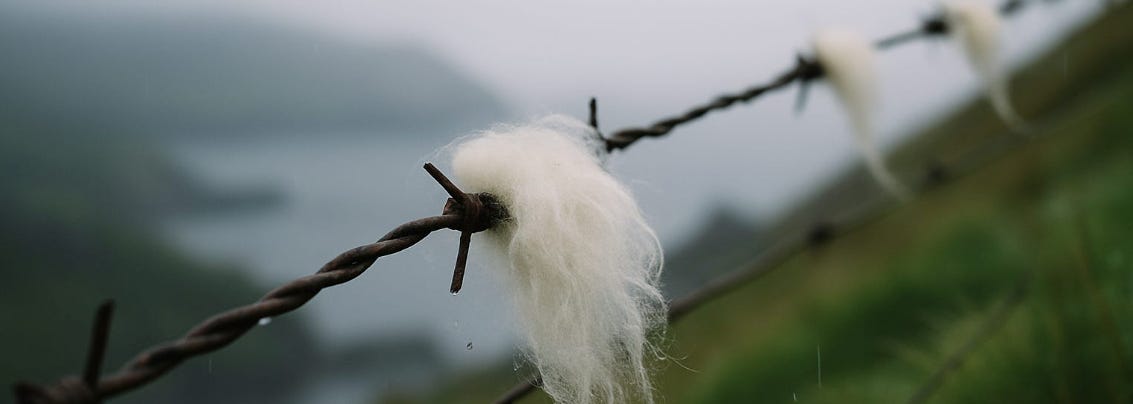
The lane rose and the land with it. He kept the Abbey to his left, a roofless patience, stones arranged into staying. He did not go in. He did not need to. It was enough to pass with it in sight. Sheep looked, decided the proper distance, and took it. Wool snagged on the barbed wire in little clouds the color of bad milk. He touched one tuft and it gave the way old things give. Grass held water low and heavy. His knee spoke its mind, sharp, ache. He listened without answering.
The path up Knocknaveen began as a suggestion and became a fact. It was not shy about its incline. It leaned out of the earth and asked for lungs and calves and the kind of attention that doesn’t need a thought. He put his head down and gave it what it wanted. Stones shifted and decided to hold. Mud took his print and kept it. Air came in, went out, asked for more. The hill did not apologize. He liked that.
At a bend, the Abbey slipped from sight, then came back smaller, then wider. The sea made a ring of itself around the island and did not agree to edges. A dog barked two fields over and found no point. He passed an engine block rusting with dignity, and cows near it trusting it to stay asleep. Thorny gorse gave out a low sweetness where it had broken. The wind carried salt and iron and the wet of sheep.
He stopped once and set his hand on his thigh above the knee and breathed until the body, which had its own ideas, agreed to go on. He thought nothing that would require a verdict. He watched his boot take hold. He looked up at a strip of sky that was lighter than the rest and kept climbing toward it, feeling alive.
The path tightened, then loosened. A fence ran alongside with its barbs honest and ordinary, wool pinned there in a row as if counted. He left it alone. The hill steepened yet again, like a final question asked without spite. He answered with his breath.
Near the top the wind came uncluttered, as if it had been saving itself for here. He set his feet on a shelf of rock and turned. Knocknaveen made a shoulder for sitting and he took it. The island fell away in fields and walls and small, kept places. Beyond, the bay gave up the white, then the gray, then the darker gray. The mainland laid itself along the horizon like something it had always meant to be.
He took a cigar from his pocket because he had brought it for this and no other time. The lighter fussed in the breeze, then gave him a flame that wobbled and held. He cupped it and drew until smoke came back at him before going. Cedar. Pepper. Damp paper. Old habit. The ash lengthened, failed, and fell. He let it.
His knee throbbed, a steady, honest song behind the breath. He set a thumb under the kneecap and pressed because that was what the hand wanted to try. It did nothing. He let the ache be.
Sheep spread below like a scattered thought. One looked up as if to ask, then asked the grass instead. Wool on wire shivered and stayed. A swallow went past at shoulder height and was gone as fast as it came. The wind moved through the short heather with the sound of a coat being brushed.
He did not assemble a speech about his brother. He did not gather stones and set them in a pattern and call the pattern anything. He let the fact come the way a cloud moves over a field, whole, not in pieces, without asking permission. There had been a time to go, and he had said after. There had been a door, and he had gotten to it late. He had been slow by the length of a breath and the weight of a bottle and the habit of holding onto something that wouldn’t matter. He let it be true, the air that took what was said and kept nothing.
A horn sounded once from the water far below, flat, unembarrassed. He smiled in spite of himself. The world was busy doing what it did whether or not he looked at it. That helped.
He drew again. The cigar end glowed and then dimmed. Smoke blew back in his face and made his eyes wet. Salt did its work around his lips. The wind pushed, eased, pushed again. Clouds opened a seam and let a strip of light cross the bay toward nothing in particular. The strip of light kept going, slow as a hand on a table. It did not hurry on his account.
He sat. He did not count time. Knocknaveen held him where he was without praise or story. The day did what a day does when it is not asked to be a lesson. The knee said what it had to say in the language it knew. Sheep tore at grass with the clean sound of small machines. Somewhere a dog started up and stopped. The sea carried the pieces of light and put them down where it liked.
He let the last inch of the cigar go cold on the rock and did not help it. He did not turn his mind toward anything that required a reply. He let the island and the mainland look at one another across the water the way old friends do, without need. The emptiness ached inside him. He breathed because breath was there.
Wind came through and went on. The strip of light lost interest in the bay and moved to a field and then to nothing and then returned as if it were all one motion. A gull hung at eye level for a beat too long and quietly slid away sideways without ceremony. The hill leaned under him.
He put his hands flat on the rock to feel the ground. He did not know what any of it meant. He did not need to. He let the weather finish the page.
The world moved on.
You write beautifully Been😊, this reminds me of a John Steinbeck's book that I really love. Thank you for this🤗