
The Line
- a short story about learning to stop enforcing the lines we no longer believe in

The Line
-by S. Francis Burns
I.
The plane door opened and the heat came in. It did not arrive in a rush. It did not need to. It filled the space the way water fills a container, taking whatever shape was available. People paused at the top of the stairs, surprised not by the temperature itself but by the fact that it had found them so quickly.
Below, the runway shimmered. The sea sat off to one side, blue and distant, like something that had already made up its mind.
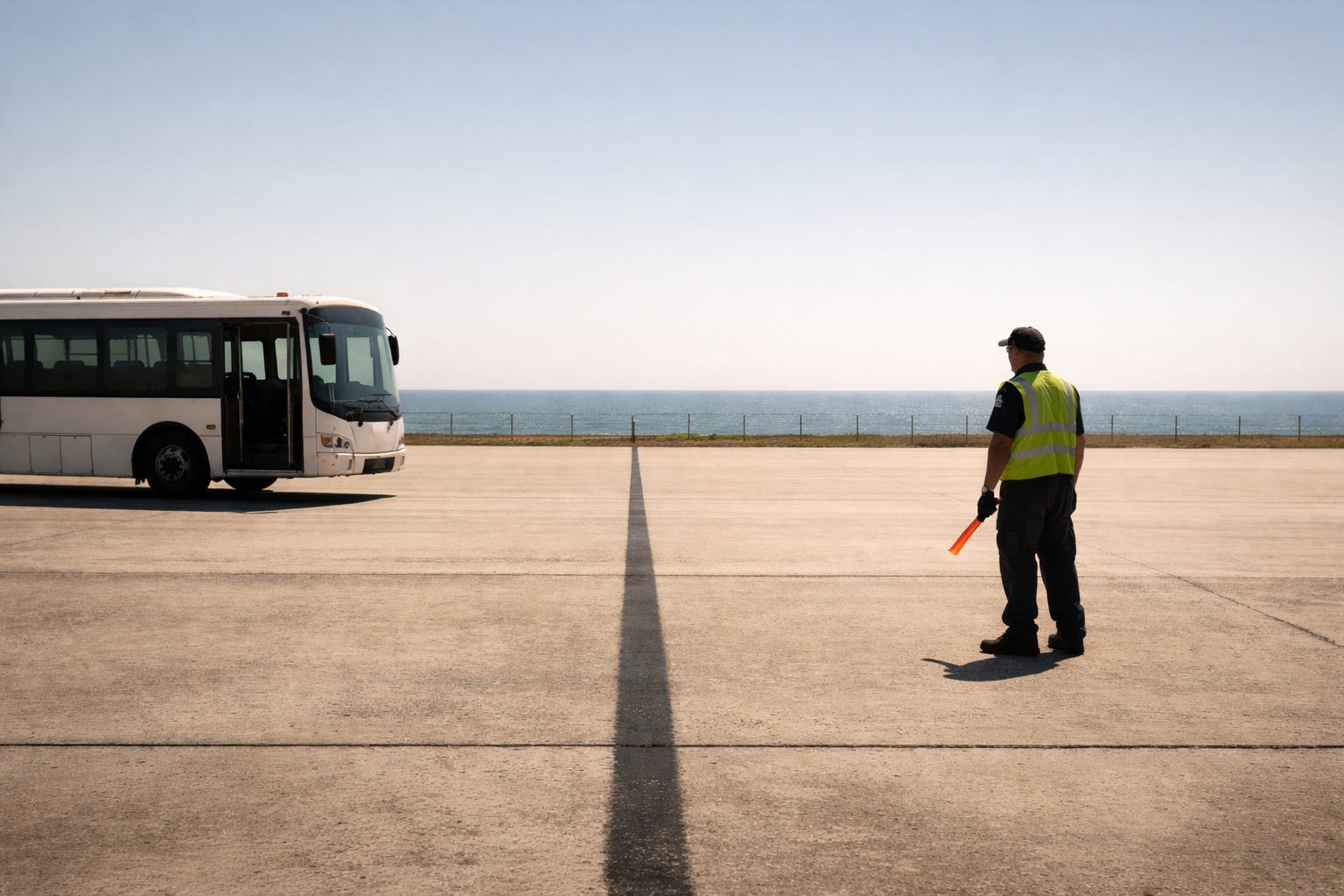
Julien stood at the bottom of the mobile stairs wearing a fresh reflective vest and holding a lighted wand. The wand glowed softly at one end in the sun, enough to suggest authority without quite delivering it. He had learned to stand slightly off-center so passengers could see past him and feel that the direction they were about to follow was their own idea.
“This way, please,” he said.
The first passengers came down cautiously, gripping the handrail as if the air itself were unstable. A man in a baseball cap laughed and said something about tropical vacations. His wife laughed too, already filing the moment away as a story.
A woman in white linen stopped directly in front of Julien.
She wore sunglasses even though the sun was already doing its work. Her skin was pale and beginning to pink. She looked like someone accustomed to being met at thresholds.
She pointed behind him. “Customs is right there.”
“Yes,” Julien said.
“So why are we getting on a bus?”
The bus waited in full sun, its engine idling. The door was open, but no air moved inside. It looked less like transportation than a concession.
Julien smiled. He had learned that smiling shortened conversations.
“This way, please,” he said again, gently.
The woman removed her sunglasses and looked at him directly.
“You know,” she said, “this is absurd.”
“Si,” Julien said.
She stepped onto the bus with care, as if entering a space that might later be used against her. The others followed. Someone laughed once, then stopped laughing when the door closed and the heat inside the bus made itself known.
The bus drove a slow, obedient loop around the back of the plane. Through the dusty windows, the passengers watched their own luggage being unloaded. No one spoke.
Five minutes later, the bus deposited them at customs entry, no more than ten feet from where they would have been if they had simply walked.
The woman in linen looked back at Julien.
“That was unnecessary,” she said.
“Yes,” he said.
She stared at him as if an apology might still arrive. Then she reached into her bag, pulled out her phone, and took a photo of him. She did not look at him again.
Julien felt nothing about it, which was how he knew he would remember it.
By the third flight of the morning, the rhythm of the day had settled.
Some passengers argued. Some surrendered. Some filmed the bus as if documentation might protect them from repetition. Julien noticed that the people who asked the most questions always boarded last.
At his break, he stood by the fence at the edge of the tarmac and looked out at the sea. The light shifted across the surface in a way that made distance hard to judge. For a moment, he thought he saw a pale straightness beneath the water, as if something had been drawn and then reconsidered. He blinked, and the water returned to being water.
He did not mention it to anyone.
At two o’clock, he washed his face in a sink that never ran cold, changed out of his vest, and walked to his other job.
The NGO office sat a few streets back from the water in a building painted white long ago and never repainted since. Inside, the air-conditioning worked steadily, irritated at being asked to hold back so much heat.
In the meeting room, Camille stood barefoot at the front, speaking with the calm speed of someone who had said these sentences many times.
Behind her, a large map covered the wall. It showed reefs and migration corridors, monitoring sites marked with colored dots. On the far left, a hard vertical line cut the island cleanly in two.
“Our monitoring sites cover the north coast, the east, and the southern shelf,” Camille said. “We’ve partnered with teams in France and Mexico on shared tagging protocols.”
People nodded. Someone typed.
Julien took his seat near the end of the table and did not look directly at the line. He had learned that certain things sharpened when stared at.
The donor arrived twenty minutes late.
She entered with the air of someone whose lateness would be forgiven. She carried herself as if the room owed her coherence. She sat near the head of the table and placed a notebook in front of her.
Julien recognized her immediately.
When the donor’s gaze reached Julien, it stopped.
Her mouth tightened slightly. Not surprise. Calibration.
“You,” she said softly. “The bus.”
Julien smiled. “Si.”
Camille stepped in. “Julien works part-time at the airport.”
The donor looked from Camille to Julien as if she had just been shown a trick.
Camille gestured toward the map. “This line marks our current grant boundary.”
Her finger rested there a moment too long.
The donor did not ask what lay on the other side. She asked about deliverables.
As the meeting ended, Camille emerged buoyant.
“You smell like airplane,” Camille said to Julien.
“It’s the jet fuel,” he said.
She leaned closer, then caught herself too late. She stayed close just long enough to be noticed by no one and felt by both of them.
“Tomorrow,” Camille said, lowering her voice, “we’re visiting a reef site. Early.”
Julien nodded.
As she turned away, Camille’s hand brushed his wrist. Not an accident.
Julien watched her go, then glanced back at the map. The imaginary line remained perfectly straight.
Outside, the heat pressed against the building. The sea continued moving, uninterested in boundaries.
II.
They left before sunrise.
The truck rattled down the narrow road with its lights off until the last possible moment. Camille liked the quiet before people arrived. She said it was the only time the island wasn’t performing.
Julien drove. He kept both hands on the wheel. The road curved in ways that suggested it had been there before anyone bothered to straighten it.
Camille sat in the passenger seat with her feet tucked under her, sunglasses already on, though the sun had not yet cleared the hills.
“Do you ever sleep,” she asked.
“Yes,” Julien said.
She smiled. “I never do.”
They drove in silence for a while. The sea appeared and disappeared between trees, flat and pale, as if it were still deciding what kind of day it would be. A manatee that no one would ever see surfaced for a moment for air.
At the site, the light came fast.
By the time the first vans arrived, the sun had established itself. Schoolchildren from the embassies and international school spilled out laughing and shoving, their shirts already darkening with sweat. Teachers attempted order and failed politely.
Camille stepped out of the truck and changed immediately. Her shoulders loosened. Her voice softened and lifted at the same time.
“Careful,” she called, as a boy leapt from a rock slick with algae.
The boy nearly fell, then laughed harder for it.
Julien unloaded equipment. He checked batteries, counted masks, tested radios. He moved through the morning with the practiced attention of someone who knew where mistakes hid.
Camille waded near the reef and began explaining shallow coral to a cluster of children.
“Alive,” she said, pointing. “It’s alive even when it looks like it isn’t.”
A girl squinted. “Does it hurt?”
Camille paused, pleased. “That’s a very good question.”
Julien watched the girl’s face. She wasn’t trying to be clever. She was asking because the answer mattered.
“Julien,” Camille called. “Come tell them about the tags.”
He hesitated for half a second, then walked over. Camille placed her hand on his shoulder as if it belonged there.
Julien held out a small tracking tag on his palm.
“This goes on a turtle,” he said.
“Does that hurt?” the same girl asked.
“No, they don’t even know it’s there,” Julien said.
The girl nodded once.
Behind them, a board member from the capital arrived, immaculate despite the heat. She wore a suit that had never been folded wrong.
“Camille,” she said warmly. “This is wonderful.”
Camille stood and smiled, a smile calibrated to include children, donors, and the horizon all at once.
The board member’s gaze moved to Julien.
“And you,” she said. “Where did we find you?”
“Here,” Julien said.
She laughed. “Local talent.”
Camille’s hand tightened slightly on his shoulder. It was meant to reassure. It felt like a reminder.
Out at sea, the divers surfaced and disappeared, their heads bobbing like punctuation marks.
Then something shifted.
It was not dramatic. There was no splash. Just a change in the surface, a darkening that moved sideways and then brightened again. The water above it shimmered with a silver flicker that did not behave like light.
A diver surfaced abruptly and shouted something. Another answered. Their voices were small and sharp.
The children fell silent.
Julien felt the hair on his arms lift.
For a moment, a pale line appeared beneath the surface. Straight. Too straight to be coral. Too coordinated to be fish.
Then it slid away and vanished.
People began talking all at once.
“Probably sargassum,” a teacher said, grateful for a word that made the ocean ordinary.
A man from the dive team pulled off his mask and squinted at the water as if it had insulted him.
“Or refraction,” he said. “Current shifts, sun hits it wrong. Looks like a seam.”
The board member nodded with relief. “There we go.” as if all was well with the world again.
Camille accepted the explanation immediately, as if acceptance itself were part of her job.
“That makes sense,” she said. “The ocean does strange things.”
Julien stayed quiet.
The diver shrugged. “Hard to say from the surface,” he added, already turning away. “Sometimes it’s nothing.”
Camille turned back to the children and smiled brightly.
“Okay,” she said. “Let’s get our hands wet.”
The moment dissolved. Adults found reasons. Children believed them.
Julien did not say anything. He held the tracking tag in his palm and felt its small weight.
Later, as the vans pulled away and the site emptied, Camille sat on the tailgate of the truck and drank water.
“You saw it,” she said.
“Yes,” Julien said.
“What do you think it was?”
He shrugged. “Something passing through.”
Camille smiled, satisfied with the answer because it did not demand anything from her.
Back at the office that afternoon, the air-conditioning failed.
Someone opened the windows. The sound of the street rose up, horns and voices and heat.
The donor called just before closing.
Camille put the phone on speaker. She liked witnesses.
“Our portfolio is shifting,” the donor said. “We need to focus on stable operating environments.”
Camille nodded as if the donor could see her.
“We should stay in scope,” the donor said.
Julien felt his jaw tighten.
“We don’t do cross-border,” Camille said quickly.
“Good,” the donor said. “Keep it clean.”
After the call, there was a silence in the room.
“It went well,” someone said.
Julien said, “It went well for the map.”
Camille dismissed everyone else and closed the door.
“Don’t joke,” she said.
“I wasn’t joking,” Julien said.
She stared at him. Then, unexpectedly, she laughed. Brittle and brief.
“You think you’re funny,” she said.
“Only at the airport,” he said.
Her laughter stopped.
“If you talk like that in front of them,” she said, “they’ll start seeing what you see.”
“And what do I see,” Julien asked.
She hesitated. Then said, “You see the line.”
“It is a line,” he said.
“It’s a budget,” she said.
They stood there, the air heavy between them.
That evening, Camille insisted Julien come to a fundraiser dinner.
“It helps,” she said. “Faces matter.”
The terrace overlooked the sea. Lanterns swayed. The water below was dark and loud.
At the table, someone asked Julien where he was from.
“France,” he said.
“And before that?”
“More water,” he said.
Laughter traveled around the table. Polite. Relieved.
“Are you married?” a woman asked Camille.
“To the reefs,” Camille said.
“And you,” the woman asked Julien.
“No,” he said. An awkward silence came over everyone at the table.
Camille’s knee touched his under the table. Deliberate.
Julien froze.
Camille’s knee moved away.
The table survived the moment by pretending it had not happened.
Later, as they stood to leave, a donor passed Julien and said softly, “You should be careful. You’re in her story.”
Julien watched Camille across the terrace, smiling brilliantly, untouched by doubt.
The sea moved steadily, as if it had never learned the word scope.
III.
That night, Julien went to his mother’s apartment instead of home.
The building sat above a shop that never fully closed. Even late, the smell of sugarcane burning in the fields nearby drifted through and settled into the walls. It made the place feel kinder than it was.
His mother had the windows open. The air moved slowly, heavy and warm. A radio murmured in the background, low enough to be mistaken for thought.
She stood at the sink rinsing rice.
“You’re late,” she said, without turning.
“I stayed longer,” Julien said.
She nodded. “They always need you longer.”
Julien took off his shoes and sat at the small table in the room that was also kitchen and living room. The surface of the table was scratched and clean. Everything in the place had been cleaned carefully enough to avoid comment. He looked forward to the moment after dinner he’d walk alone upstairs to the rooftop.
His mother covered the pot with a plate and turned off the stove. She reached into a drawer and brought out the folder.
It had once been blue. Now it was gray at the edges, softened by years of handling. It lived with the good scissors and the emergency candles.
She set it between them.
“They called again,” she said.
Julien did not open it.
“When,” he asked.
“This afternoon.”
“What do they want.”
She wiped her hands on a towel. “Our papers. The original.”
Julien closed his eyes for a moment.
“They already have it.”
“They have a copy,” she said. “Now they want to see it breathe.”
Julien opened the folder. The papers lay flat and obedient. Birth certificates. Permits. Letters. Proof stacked on proof.
The Haitian stamp sat on one page, faded and official, like a bruise that had learned how to behave.
“Why does it always change?” Julien asked.
His mother leaned against the counter and crossed her arms.
“If it stayed the same,” she said, “they could not pretend it was fair.”
Julien nodded.
Outside, a motorcycle passed, loud and unconcerned.
His mother poured water into a glass and slid it toward him.
“You look tired,” she said.
“I am.”
She studied him now, the way people who have waited learn to study weather.
“Is it the ocean job?” she asked.
“Yes.”
“And the woman.”
Julien hesitated.
“She’s just working,” he said.
His mother smiled faintly. “She is always working.”
Julien looked up. “You know her?”
“Everyone knows her,” his mother said. “She is on the radio. She is on posters. She stands where people like to look.”
Julien said nothing.
His mother lifted a page from the folder and held it by the corner.
“When we first went to France,” she said, “they told us it would be easier after.”
“After what?” Julien asked.
She smiled without humor. “After we were done being new.”
Julien traced the table edge with his finger.
“I kept everything,” she said. “Every letter. Every stamp. Your father said I was being dramatic.”
“What did you say.”
“I said paper remembers,” she said. “People forget.”
She closed the folder gently.
“Why do you work at the airport,” she asked.
Julien thought of the stairs, the heat, the wand, the bus.
“Because it’s honest work, and we need the extra money.” he said.
She considered this.
“At the airport,” she said, “everyone is what they are. No one pretends?”
Julien nodded.
“They are tired. They want to move.”
“Yes.”
She looked at him steadily. “And you.”
Julien did not answer.
The rice finished cooking and she sat across from him.
“If life becomes difficult,” she said, “you choose how much difficulty you want to bear.”
Julien looked at the folder.
“What if I choose wrong,” he asked.
She reached across the table and covered his hand.
“We chose wrong many times,” she said. “We are still here.”
Later, as he stood to leave, she handed him the folder.
“Take it,” she said.
At the door, she touched his cheek.
“Be careful son,” she said. “You are useful to many stories.”
Julien nodded and stepped into the night, the folder tucked under his arm like something alive.
IV.
Camille stayed after everyone left.
The office quieted into something like a held breath. The air-conditioning had been turned off to save money, and the room began to warm in the slow, patient way heat always does when it knows it will win.
She loosened her hair and leaned back in her chair. The map still hung on the wall, bright and confident, as if it had not just been rendered provisional.
Her phone rang.
She answered without looking at the screen.
“Yes,” she said. “I was expecting your call.”
She listened, nodding, pen already moving across a pad.
“No,” she said. “I understand. Completely.”
A pause.
“Yes, we can reframe that.”
Another pause.
“Yes. Narrower scope.”
She stood and walked toward the window while she listened. Outside, the street moved the way it always did. Motorcycles. Voices. A fruit cart setting up again for evening, as if the day had not already taken enough.
“If we insist on everything,” she said carefully, “we get nothing.”
She stopped pacing and looked back at the map.
“Yes,” she said. “I’m aware of what we’d be leaving.”
She did not raise her voice. She did not plead. She spoke the way people speak when they have already accepted the loss and are choosing which parts to keep alive.
“We can maintain continuity here,” she said, tapping her pen against the desk. “We can protect the data that matters.”
A longer pause.
“No,” she said. “I won’t say it’s temporary if it isn’t.”
She listened again, then nodded once, sharply, as if agreeing with herself.
“Yes,” she said. “Send me the wording.”
When the call ended, Camille did not move.
She stayed standing, phone still in her hand, and stared at the wall where the map hung.
She knew exactly what Julien would think.
That was the problem. She had always known what idealists would think. She had once been one herself.
She walked to the wall and rested her palm flat against the map. It was warm from the day. Paper and ink, pretending to be the ocean.
“You don’t save everything,” she said aloud, quietly. “You save something.”
She thought of the first year. Of sleeping in her car. Of the La Niña they all knew was coming in a matter of years to wipe everything out. Of the reef bleaching. Of the grant that fell through and the one that didn’t. Of the small compromises that had kept the doors open.
She thought of how often survival looked like betrayal.
Her phone buzzed again. A text from a secondary funder asking for an updated site breakdown by morning.
She exhaled and sat back down, and worked into the night.
V.
The next morning, the primary funding decision arrived.
Camille read it standing.
Her voice changed before the words did.
“They’re pulling it,” she said.
She moved quickly, filling the room with plans. Bridge funding. Emergency calls. Language that made the future sound reachable.
Julien listened. He felt something loosen in his chest, not joy, not relief exactly. The absence of a pressure he had forgotten was there.
When the room emptied, he went to the map.
The map covered the wall, bright and confident. The hard line on the left was perfectly straight. A whole invisible population existed on the other side of that imaginary line.
Julien stood there a long time.
That afternoon, after everyone left, he returned, reached up, and peeled the tape at the top edge. Slowly. Carefully. The paper came free with a soft tearing sound.
He rolled the map from right to left. When he reached the line, he paused, then continued, pressing it into the curl until it vanished.
He leaned the roll behind a stack of old brochures and turned off the light.
The cost of his action appeared the next morning.
A junior coordinator stood in the meeting room with a laptop open and a confused expression.
“I’m sorry,” she said, glancing between Julien and Camille. “The donor needs a screenshot of the updated map for their board packet. They need it in ten minutes.”
Camille turned toward the wall.
The space was blank. Faint tape marks caught the light like ghosts.
She closed her eyes briefly.
“Print the backup,” she said.
“There isn’t one,” the coordinator said. “We were updating live.”
Camille looked at Julien.
He did not speak.
“Redraw it,” Camille said, already pulling a chair to the table. “From memory.”
They worked quickly. Lines were guessed. Distances approximated. Someone asked which sites had been paused. No one answered right away.
The coordinator refreshed her inbox repeatedly.
“We missed the upload window,” she said finally.
Camille nodded once. She did not look at Julien.
“That’s fine,” she said. “Send it anyway.”
The coordinator hesitated. “It won’t match the last version.”
Camille said, “Send it.”
Julien watched the cursor hover, then click.
No one blamed him out loud.
He gathered his notebook and left the room.
VI.
In the morning, Camille stood in the meeting room staring at the blank wall.
“Where is it,” she asked.
“I put it away,” Julien said.
Her face tightened.
“You don’t get to decide that. You can’t do this to my life’s work.”
“I did.”
“This is betrayal,” she said, the word sharp with certainty. Her cheeks burned.
Julien felt steady.
“It’s not,” he said.
“What is it then?”
“It’s a gift. You’re free.”
She laughed once, disbelieving.
“Go,” she said. “Go direct people onto their stupid bus.”
Julien left without speaking.
At the airport, the day was bright and merciless.
The plane door opened.
The heat came in.
Julien lifted the wand.
“This way, please.”
The bus idled. The loop waited.
As the passengers disembarked, a man and a woman hesitated. They looked at the ten feet between the stairs and customs.
The man shrugged.
“We can walk,” he said.
They stepped off the curb and crossed the lane.
Julien lowered the wand. No one stopped them. The bus driver did the loop anyway, no passengers.
For the rest of the day, he kept lifting the wand, directing. But sometimes, when people paused, he did not repeat himself.
At dusk, he stood by the fence and looked out at the sea.
The light thinned. The surface darkened.
For a moment, far offshore, a pale straightness appeared beneath the water. Not bright this time. Just visible enough to notice.
Another worker stood beside him.
“You see that?” the man said.
Julien nodded.
That night, Julien brought the rolled map back to his mother’s apartment.
“You stole the ocean?” she laughed.
“It was on a wall,” he said.
She studied him.
“You will lose your job. She might too.”
“Maybe.”
She smiled. “Maybe is better than always.”
In the morning, Camille stood in the office with her hands flat on the table.
“I don’t know what to do with you,” she said.
“You don’t have to,” Julien said.
Outside, the wind lifted off the sea. The smell of rain moved through the open window. The reef breathed.
At the airport, the plane door opened again.
The heat came in.
Julien raised the wand.
“This way, please,” he said.
He watched the people at the top of the stairs.
And for the first time, he waited to see which way they chose.
Beautiful