
Unavailable 利用不可
- a short story about the Age of Dissolving Truth

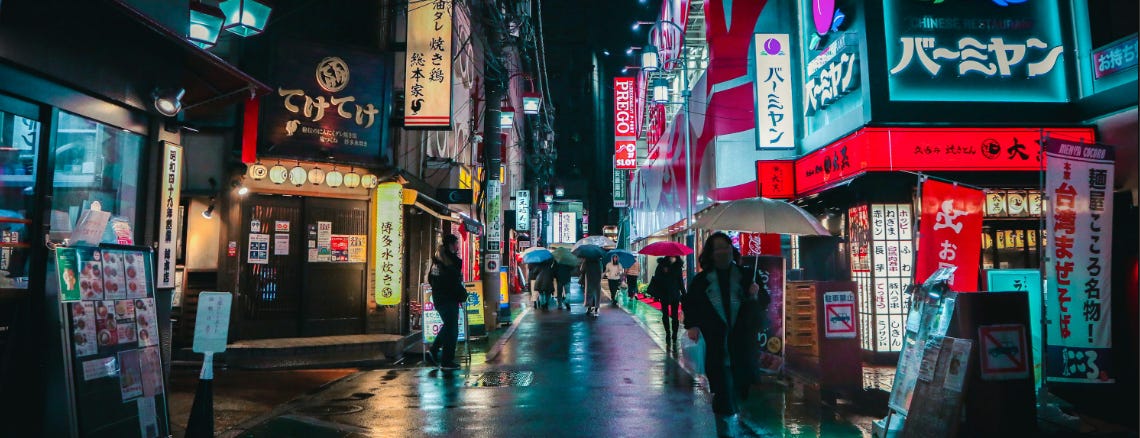
Unavailable 利用不可
- by S. Francis Burns
Scene I: Refusal
The rain had thinned to a lace. It hissed in the gutters behind the station, carrying wrappers, a snapped umbrella rib, the paper collar from someone’s onigiri. Koji Tanaka walked with his head down, collar damp, the city’s humidity pressing through him anyway.
A row of vending machines glowed along the corrugated wall. Their faces were no longer buttons or slots but smooth panes of glass, blank until they sensed him. As he stepped closer, one brightened, bathing his face in pale light. He leaned in without thinking, letting the scanner read him.
There was a pause, long enough to feel personal. Then a square of white text bloomed:
Unavailable.
Koji blinked at it. No reason. Just the one word.
He leaned in again. A faint hum, another scan of his eyes, his face, his posture. Then the same verdict, politely firm. Unavailable.
His throat was dry. He could taste the smoke that had drifted from the yakitori stand two blocks back. It should have been simple, step up, get water, move on.
But the thought came instantly, as if waiting for this moment. It knows.
A heat rose in him, then dropped, like missing a stair in the dark. He caught his reflection in the machine: damp hair curling at the temples, the soft sag of travel under his eyes. Ordinary. Too ordinary. And yet the thought sat with him like an old acquaintance: It knows what you did.
Behind him, under the tracks, a train sighed past, the sound a metallic ocean. A boy stepped up beside him, phone in hand. The machine recognized him instantly: face lit green, bottle released with a cheerful clink. The boy bowed slightly, the polite bow of strangers, and walked off without meeting Koji’s eyes.
He tried to laugh at himself. Glitch. Server down. A hiccup in some offshore cloud. Still, the refusal clung, light and unbearable. He touched his cheek as if the scanner had left a mark.
Further down, an old ramen shop was closing. The cook scrubbed the counter with the weary rhythm of a man who had been upright too long. Across the lane, a woman with a broken umbrella stared at nothing, waiting as though for instructions.
Koji moved on.
The city smelled of soy, brakes, damp concrete. Pachinko parlors bled metallic rain into the alleys. Above a laundromat, a single sock sagged from a balcony, heavy with water. Screens flickered in windows, news anchors too flawless, mouths moving a fraction behind the sound. Headlines scrolled with words he half-believed, half-didn’t.
He felt the strange texture of truth dissolving. Everything broadcast, everything certain, and yet nothing held. Even the memory of what he had done, was it clear? Or had it been replayed so many times in his head, patched with fragments of feeds, that he no longer knew if he carried the truth of it, or only its ghost?
At a convenience store, fluorescent lights promised comfort. He chose water, stood at the self-checkout. The scanner bathed him in the same pale wash. For a moment he thought it would relent. Then: Unable to process. Please see staff.
The clerk hurried over, smile fixed, hands raised in apology. “Sumimasen.” He tapped the terminal, tried an override, shook his head softly. “Maybe… cash?”
“I don’t carry cash.”
The smile deepened, helpless. The clerk glanced toward the ceiling as if the answer lived there, invisible. The people in line shifted, polite but impatient. A group of teenagers stared into their phones, their faces filtered into mirror-skinned perfection.
Koji set the water down, bowing too deeply. “It’s fine.”
Outside, the bell over the door chimed. The sound felt like a dismissal.
He stood at the rail along the storefront, breathing. Reflections stacked in the glass: his own face, the glowing headlines, the green of an exit sign pointing nowhere. Who ran these systems anymore? He couldn’t name a single person. The decisions that allowed him or denied him seemed to arrive from nowhere, like weather.
Maybe that was the worst of it, not some hidden hand, but the absence of one.
His phone buzzed. He didn’t look. He knew it was one of the three people who still expected something of him. His ex-wife. His daughter. His mother in Portland, her voice thinned by distance. He let it vibrate out. The silence afterward felt like a debt added to an old account.
He drifted toward the station. Fare gates blinked green for everyone, swallowing them into the night. When he approached, the scanner took its pause, its long look, then closed the gates on him. A girl nearly walked into him. He stepped aside, murmured apology. She didn’t break stride, just took the next gate, green as spring.
The attendant in the booth looked up, hand half-raised, as if to offer help. Koji shook his head with a small smile. Better to seem a man who had changed his mind than a man refused. He turned away, back into the rain.
By the time he reached his hotel, the storm had thinned to mist. The lobby smelled of lilies and disinfectant. The piano soundtrack smoothed the edges off every note. The clerk nodded at him warmly, professionally. He nodded back, carrying the refusal upstairs like a weight in his pocket.
In the room, he stood at the window. Red lights moved along cranes in the distance. The city hummed, seamless, endless. His phone lay face down on the desk. He flipped it: two messages. One from an unlisted number. One from his daughter. The preview text said only: Hey…
He let the screen darken. He lit a cigarette, drew once, then crushed it in the sink. The room smelled of damp smoke and something faintly sweet, like coins.
On the nightstand, the hotel’s tablet flickered with koi. He stared at them until they scattered, replaced by menus for spa services, weather, restaurants that never closed. News ticked by at the bottom. Numbers, names, stories, truths, fictions, impossible to separate.
He shut it off. Darkness folded over him. The word from the machine returned, heavy as a stone.
Unavailable.
Koji closed his eyes. He did not sleep.
Scene II: Witness
He didn’t sleep. At two he gave up pretending and went back outside. The mist had turned to a cold, fine rain that lifted the smells, soy, diesel, something sweet and rotten from a drain. He let it wet his hair. The streets around the station were half-empty, the way a chest sounds between coughs.
He walked without aim. Kabukichō’s signs floated like paper lanterns. Hosts with perfect hair leaned in doorways, smoking the last inch of their cigarettes like they were saving it for later. A woman in a glitter dress ate noodles out of a plastic bowl, leaning against a shuttered pawn shop. She slurped with care and stared at nothing at all.
He passed a scooter rack. The units stood in a neat row like obedient dogs. A small eye above the handlebar watched the sidewalk. He lifted one by the stem. The eye woke, washed his face in light, blinked once. Unavailable. He set the scooter back in place, steadying it with both hands as if it were a person who might fall.
He laughed. It made no sound. Rain clicked on the plastic fenders, a tiny applause for nothing.
He cut down a side street. A vending cupboard offered umbrellas, thin and clear as the skin on cooling milk. He stepped close. The sensor warmed, felt him, hummed. Then the same word. He stood there and touched his cheek with two fingers, as if he could rub off whatever it was the city had decided he was.
The cafés thinned to convenience stores, the convenience stores to dark fronts with blue security lights. A man slept on a bench with his tie looped around his head like a bandage. Another man retched into a gutter and then bowed to the gutter when he was finished. Koji skirted them both and placed his feet carefully, as if stepping over names painted on the street.
His phone buzzed. He didn’t look. He let it run out its little coil of urgency and then die.
When he reached the corner with the big red cat sign, he turned left out of habit. The alley opened into a small square. At the far end was a twenty-four-hour café with a picture window fogged to the waist. The sign above the door advertised Morning Set with a photo of thick toast and a boiled egg. It was night. The door chimed when he pushed it. The chime was trying to be cheerful and wouldn’t quite get there.
Inside, the light was too clean. Vinyl booths. A counter with six stools. A menu under glass, laminated long enough ago to be wavy. A TV hung in the corner. An anchor with a flawless face spoke in a tone that should have soothed. Her mouth moved just behind the words. Headlines ran past like fish.
Koji took a seat near the window. Condensation made rivers on the glass and collected in a little puddle on the sill. He put his hands around the puddle to feel the cold. A server in her fifties came over with a pad she didn’t look at.
“Coffee?” she said.
“Yes. Coffee.”
“Hot?”
He nodded. She wore a plastic bracelet the color of cough syrup. The elastic had given up and it slid up and down her wrist each time she moved her hand.
At the counter two office workers sat hunched over bowls. Their jackets were folded with care over their laps, as if to protect them from falling rice. One dabbed at his forehead with the corner of a napkin. The other stared into his soup like a man reading omens.
Koji’s coffee arrived in a cup with a chipped ear. It tasted like burnt sugar and something old. He was grateful for it. It kept his hands occupied. He watched the anchor smile. Her skin had no pores. The lower third promised a storm, then denied it, then warned of a strike, then reported a truce, then corrected a figure in a way that made the first figure feel more true. He looked at the server. She wasn’t watching the TV. She watched the door.
A man came in.
Black suit, crisp but tired. Hair cut close. A faint tattoo peered under the cuff when he lifted a hand to brush water from his sleeve. He didn’t look at anyone. He took the stool at the far end and raised two fingers. The server brought him tea without asking. He drank it in three swallows and set the cup down too hard.
One of the office workers glanced at him and then away. The other bumped his bowl with his elbow, hands clumsy, broth sloshing onto the counter. The man in the black suit turned his head a degree.
“Sumimasen,” the worker said, bowing to his soup.
The man in the black suit didn’t answer. He tapped the counter with one fingernail, a small sound, measured. The server watched his hand and then his mouth.
Koji sipped his coffee and tried to measure the room. He found the cameras, one above the register, one in the corner near the TV, the red dot steady as a held breath. He rubbed his thumb against the cup’s handle until heat bit him.
The office workers went back to their bowls. The one on the right whispered something that was not a whisper. The one on the left stiffened. He put his chopsticks down carefully. His hands shook. “You always,” he began, and then stopped. He stared at his colleague. “You always…” He made a small, helpless motion, the gesture for everything.
The man in the black suit smiled at nothing. It was not a kind smile. It was bored.
The server poured more water into the workers’ glasses. Her hand shook once and stilled. “Take it easy,” she said, a phrase that sounded borrowed from another language.
On the TV the anchor laughed at a joke no one had told. The laugh continued a second past the cut to a drowned highway. The caption read: Authorities assure public systems remain stable. The bottom bar rolled a list of officials’ names and times they would appear, and then an apology that they would not be appearing.
The worker on the left pushed his bowl away. “You forwarded it,” he said.
The worker on the right wiped his mouth. “I escalated it. That’s the process.”
“You escalated it at midnight.”
“That’s when the system flagged it. You were tagged for response. I responded. I did what…”
“You escalated to Sato.”
“That’s the rule. Visibility. You said transparency is good.”
“It was a draft,” the left-hand worker said. His voice broke on draft. “A draft. You put it into the stream and now it’s in the stream.” He looked around as if the stream might be visible, running along the ceiling.
“Please,” the server said quietly. “Please.”
The man in the black suit leaned back. His knee touched the empty stool beside him and kept pressing, a rhythm with no music.
Koji took a breath that didn’t go anywhere. A memory opened in him like a door: his mother in Portland, the way she rolled the word honey in her mouth until it was warm. He couldn’t hear the end of her sentence. He had cut it off by not answering. The guilt arrived without image, just weight.
The left-hand worker stood. His knee hit the counter and the tea cup fell and cracked. The sound was small but everyone looked. The man in the black suit turned his head the rest of the way and examined the break as if it contained a message.
“You should have had my back,” the left-hand worker said.
“I followed policy,” the right-hand worker said. He did not stand. He did not look at his colleague. He addressed his bowl. “It’s always-on. You know that.”
“Always-on,” the other said, as if he were tasting something spoiled.
The man in the black suit slid his empty cup two inches, the way you invite attention without asking for it. The server moved toward him and then, seeing the tension by the counter, moved toward that instead. Her bracelet slid to her knuckles and back.
Koji put his cup down. He felt the urge to stand, to place a hand on someone’s forearm, to say a word that might interrupt the shape the night was taking. He saw the camera’s red eye. He felt it look at him and note: movement, proximity, vector. He saw himself from above, face caught halfway to an expression that could be read a dozen different ways by a dozen different systems. He stayed seated.
The left-hand worker grabbed the right-hand worker by the lapels and shook him once. The right-hand worker’s head bobbed. The shake had the tired clumsiness of two brothers fighting at the end of a long day. The man in the black suit made a sound like a small laugh and then stopped, as if bored even with that.
“Outside,” the server said, voice low. “Please, outside.”
The left-hand worker slapped the right-hand worker open-handed. The sound was flat and awful. A white line showed on the cheek and then reddened. The right-hand worker flinched and stood up too hard, knees sliding the stool back until it hit Koji’s table. The table jumped and coffee shuddered out and burned his fingers. Koji hissed and pulled his hand back like a child.
“Enough,” the server said. She moved between them and then stepped back immediately, calculation crossing her face, if she were grabbed, if someone filmed that, if the system flagged “assault,” what would land on her, on the owner, on the lease. She hovered at the edge and wrung a napkin in her hands until it became a rope.
The man in the black suit spoke for the first time. “Calm down,” he said mildly, as if giving directions to a library. He didn’t look at either worker. He looked at the TV. On the screen a graphic showed a network diagram with lines out to the edges and no center.
The right-hand worker pushed the left-hand worker. The push was meant to be gentle and wasn’t. The left-hand worker stumbled, hit his hip on the counter, made a small surprised sound, and then swung. His fist clipped the right-hand worker’s nose. The right-hand worker reeled and put a hand to his face. Blood ran fast, theatrical, down between his fingers and onto his tie, little red punctuation marks on silk.
Koji stood halfway without knowing he was standing. The camera’s eye pulsed. The server moved toward the napkin dispenser and then away from it, as if napkins could be weapons or evidence.
“Stop,” the server said. “Please.”
The right-hand worker roared, a sound that didn’t seem to belong to him, and drove the left-hand worker backward. They hit a chair and fell in a slow knot. The man in the black suit slid his stool three inches back to keep his shoes clean. He was smiling again, admiring or bored; it was hard to tell.
Koji reached for the men and stopped his hand in the air. In his head he saw the chain: the grab, the camera frame, the system flagging his handle, the gates closing, the machines refusing him, the line somewhere assigning him a score he could not see. He closed his hand in the air and brought it back empty.
“Outside,” the server said again, voice hoarse.
The two men broke apart and then came together again without purpose, as if the fight were a dance they didn’t know the steps to. The right-hand worker’s nose bled freely. The left-hand worker panted like a dog. Koji could see the wet at the corners of his eyes. The man in the black suit stood. The room thinned, as if someone had opened a window.
He took one step toward them and then stopped, not from fear, but from a lazy violence that said he would enjoy it too much. He put a note under his empty cup and walked out. The door chimed, cheerful and false.
The fight lost its spark the moment the black suit left. The right-hand worker sagged against a chair. The left-hand worker sat on the floor and pressed his palms together, not in prayer but to keep them from shaking. The server moved in with a towel like a flag of truce.
Koji sat back down. His coffee had gone cold. The TV anchor blinked and delivered a correction to the correction in the same even tone. Public systems are operating normally, she said. In the corner of the screen a map flickered, stuttered, and reset.
“Gomen,” the left-hand worker said to the room. He said it to the server, to the counter, to the city. The right-hand worker kept his hand over his nose and stared at his shoes. Blood dripped onto the tile in neat, incriminating dots.
The server brought a mop bucket from the back and set it beside the dots. She knelt and wiped them up as if they were small, stubborn children. She didn’t look at the camera. She didn’t look at Koji. She cleaned the floor with hard, short strokes that made her bracelet ride up and down her wrist in a small storm.
“Do you want ice?” she asked.
The right-hand worker nodded. She brought a plastic bag with cubes. He held it to his face and flinched. The left-hand worker bowed from the waist while sitting, a ridiculous angle, and said Sumimasen again. He sniffed. He was very close to crying or very far from it. It was hard to tell.
Koji stood and went to the register. The server followed, wiping her hands on a towel that had already surrendered. He pointed at the coffee cup. She punched the amount into the terminal and turned the screen toward him. He leaned in. The scan washed over him, paused.
Unable to process. Please see staff.
She watched the screen and then his face. The way she breathed before she spoke told him that she had already decided. “It’s okay,” she said. “Next time.”
He shook his head. “I’ll come back.” The words sounded like a lie in his own mouth.
“It’s okay,” she said again, without warmth, without resentment. It was simply the answer that made the night move.
He bowed. She bowed. The right-hand worker held the ice to his nose and made a small sound. The left-hand worker sat very still, hands locked together, as if he were trying to keep himself inside the shape of his body.
Koji stepped into the rain. It had found a steadier rhythm. The glass fogged over almost immediately, turning the café into a jellyfish lantern. The anchor’s mouth moved behind the blur, saying something someone would later correct.
He looked up at the camera mounted above the door. A red dot stared back. He imagined a room somewhere below ground where the feeds converged into a nervous system that belonged to no one. He tried to picture the person who would watch this footage. He couldn’t. He tried to picture the algorithm that would watch it instead. He could only see a hand drawing a circle and then leaving the circle empty.
He walked. The streets widened. The last trains were gone. Drunks curled like commas in doorways. A police box glowed on the corner. Inside, two officers stared at a wall of monitors. One of the monitors showed the café. Koji couldn’t tell if it was live. He couldn’t tell if the officers were awake.
He crossed in the rain without waiting for the light. A speaker somewhere told him not to do that, very politely. He stepped on the white line and left a wet shoe shape that filled slowly with water and then disappeared.
He thought of calling his daughter. He pictured her face lit by her screen, hair pulled back, the small line she made with her mouth when she was trying not to ask for something. He put his hand on his phone and then took it away. He wanted to be the man who stepped toward the fight. He wanted to be the man who called. He kept walking.
At the edge of the district he found a pedestrian bridge. He climbed, feeling each step in his knees. Halfway up he stopped and looked back. The city hummed, gorgeous and tired. A delivery bot whispered by on the sidewalk below, its lid beaded with rain. It paused to recalibrate, decided what the night required of it, and rolled on.
Koji reached the top and stood under the single light, the one that hummed at a pitch you felt more than heard. Cars slid under him with a soft tire roar. Somewhere a siren drew a line and cut it. He rested his hands on the rail. The metal was cold and clean. He breathed through his mouth until the taste of old coffee went away.
He stayed there until the sky began to change without anyone’s permission. The rain eased. The buildings softened at the edges. Behind him, the café door chimed once and then again, faint and friendly, as if nothing had happened at all.
Scene III: The Edge
Dawn came in layers. First the pale thinning of the sky above Shinjuku, then the lights of the towers blinking off one by one, reluctant to admit they were no longer needed. Koji stayed on the pedestrian bridge until his legs grew stiff. Beneath him, taxis prowled like yellow fish, slowing for men in crumpled suits who lifted hands without conviction.
He walked down. The pavement was slick, painted with faint reds and greens from signs that had not yet surrendered. He passed a bakery already awake, the scent of yeast rising into the wet air. The woman behind the counter was arranging trays of melon bread, her motions exact, priestly. For a moment he thought of stepping inside, holding up a coin, offering something simple. He kept walking.
At the corner, a city sweeper moved a wide broom across the gutter. The broom made a dry whisper, collecting cigarette ends and wilted receipts into a small, sad nest. The man’s uniform was neat, his cap pulled low, but his movements were the movements of someone who had made peace with repetition. He did not look up.
Koji entered a small park bounded by rails and vending machines. The ground was littered with wet sakura petals left from some tree he couldn’t see. Benches ringed the space. He chose one and sat.
From here, the skyline was visible, the orange spike of Tokyo Tower in the distance, the quilt of windows waking in waves. The city looked almost innocent in the half-light, as if the night’s violence, the refusals, the word Unavailable had been washed away with the rain.
He leaned forward, elbows on knees. His phone was heavy in his pocket. He pulled it out and turned it over. The screen woke instantly, as though eager.
One unread voicemail. His daughter’s name glowed there, four simple characters that seemed older than she was. He touched it. The line opened with a faint click, a soft rush of static, then her voice.
“Hey, Dad… it’s late, I know you’re busy. I just wanted to tell you…”
She paused. In the pause, he could hear the shuffle of her breath, the faint clatter of something in the background, dishes, maybe, or the hum of the apartment fridge.
“…I just wanted to tell you goodnight.”
The message ended there, abrupt, as if she had run out of courage or thought better of it. The phone asked if he wanted to replay, save, or delete. He did none of these. He held it in his hand until the options faded.
The light grew stronger. Crows gathered on the wires, their black shapes crisp against the sky. They argued in short, sharp bursts, as if each had the final word. A jogger passed with headphones, his breath rhythmic, indifferent. Koji watched him disappear down the slope.
He thought of calling back. He pictured her sleepy voice, the way she would try to sound cheerful even if she wasn’t. He pictured silence on the other end, his own mouth failing to open. He closed his eyes.
The bench was cold through his coat. The air smelled of earth waking, rain lifting. His phone slipped from his hand and landed face down on the wood beside him. He left it there.
Above, the sky brightened to a pale gray that promised a clearer blue later. For a moment the city was quiet, the kind of quiet that doesn’t last but feels eternal while it’s there.
Koji breathed in, then out. He let the breath go all the way.
The machines would wake again. The gates would open for some and close for others. The anchors would smile with faces no one could touch. His mother would call. His daughter would wait. He would walk back into it.
But for now, just now, the morning had no verdict.
The wet petals clung to his shoes. The air shifted with the faint warmth of a coming sun.
I love how detailed the descriptions are. You are an excellent writer Sir 🥹